Is cash king as interest rates soar to tackle inflation?

Is cash still king?
Banks and building societies are advertising the best savings rates seen for some years, reflecting the sharply tightening monetary policies of central banks around the world. These are enticing after the turmoil that impacted equities and bonds so negatively in 2022. But are cash deposits a serious option for investors seeking to make real wealth gains over the longer term? Will they beat the high levels of inflation being seen globally?
Inflation has ebbed and flowed
Historically, cash has a good track record versus inflation. Real interest rates – nominal interest rate less inflation – normally had to exceed inflation to control it. Cash also deserves a risk premium: investors are taking the risk that the institutions to which they lend go out of business and hence should be rewarded.
Then the Global Financial Crisis (GFC) hit in 2008. Central banks embarked on ultra-loose monetary policies and the biggest ever programme of quantitative easing to restore liquidity to a financial system that threatened to freeze. Interest rates declined and cash deposits became all the less attractive. But no matter how loose policy became, it seemed nigh on impossible to generate inflation.
The post-Covid fiscal looseness, combined with Russia’s invasion of Ukraine changed the dynamics once again. Shortages of key commodities, especially oil and gas, fed into an economy that was already suffering supply side issues because of the Covid pandemic. In 2022, central banks around the world embarked on monetary tightening that has involved some of the most aggressive rate hikes ever seen.
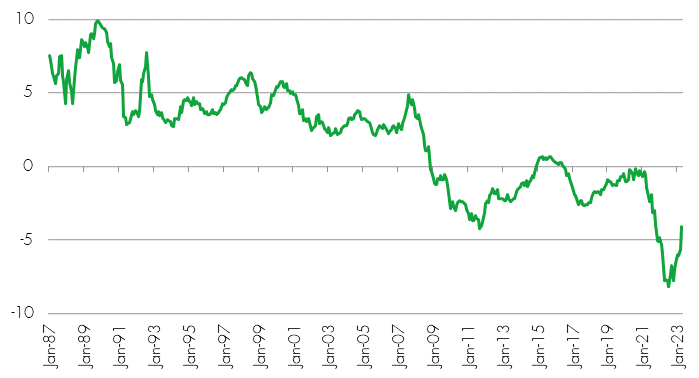
The relative performance of cash, as measured by three-month Libor, versus UK inflation since 1987 is illustrated in Fig. 1. It shows how the real interest rate was highest during the inflation-tackling era of the 1980s but declined gradually until turning negative from the GFC onwards. Apart from a short period in 2015-16 when they were slightly positive, they have remained negative ever since, reaching a nadir in 2022 when rate hikes lagged the rampant inflation.
Fig. 1: Real UK interest rates, 1987-2023
Alternatives to cash
Investors have many other options apart from cash, of course. The other two main asset classes are bonds and equities, both of which offer attractive long-term risk-return profiles that can be used effectively to diversify portfolios.
Equities are generally regarded as offering the strongest returns over the long term, although they are significantly more volatile than cash. Holding equities is fractional ownership of the prospects of a business generating capital growth and income from dividends. Although some companies do fall by the wayside, historically, companies have proved to be highly successful at generating returns that exceed inflation, as demonstrated by the long-term returns of stock markets. Companies are seen as having an in-built defense against inflation because they can pass increasing costs onto consumers by raising their prices, although this will depend on the market power that they wield.
For example, Fig. 2 shows how the total returns from equities have outstripped inflation in most of the years between 1990 to present, sometimes by 100% or more.
Fig. 2: Rolling six-month total return on UK equity from 1990 to 2023

The value of the interest, or ‘coupons’, that bonds offer does vary according to the creditworthiness of the borrower. For example, developed market government bonds tend to be lower risk than investment grade or high yield company bonds because of their reliability. Fig. 3 shows how the yield on two-year UK government bonds, also known as gilts, has remained in positive territory since 2002 apart from 2020-21.
Fig. 3: Gilt yields versus FTSE 100 dividends
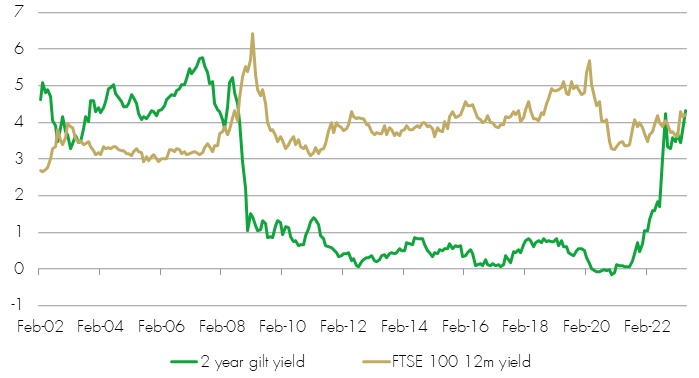
Gilts have become a meaningful income alternative to equities for the first time in years because of their current yields, which make them all the more useful at present from a portfolio construction perspective. Investors should remember that there is a trade-off between risk and return in a free market in that the greater the risk involved in an asset, the greater the potential return. This trade-off tends to be more consistent over time and across asset types. Cash and government bonds are lowest risk but both generate lower long-term returns than equities, which lie at the other end of the risk-return spectrum. In between these poles are high yield bonds, which are higher risk than most fixed income but lower risk than equities.
Fig. 4: UK equity returns outstrip inflation over the long-term

Beyond cash assets
Past performance should not be used as a guide for future returns, but one of the biggest mistakes in investing is to think that ‘it is different this time.’ Investors may look at global financial markets now and feel concern about the volatility seen in recent years. There are certainly risks, and our own view is that the best antidote to this is diversification. But if investors are concerned about whether their returns can exceed price rises then the current rates of inflation and interest rates mean they must look to non-cash assets if they are to have a prospect of doing so. The shortfall of cash versus inflation on current rates will only be exacerbated the longer that investments are parked in savings accounts that pay negative rates versus inflation. Cash plays a role in balancing the risks in diversified portfolios, but the world offers a much wider choice of investment assets with the potential to enhance long-term returns. The evidence points to equities being the best way to beat inflation over the long term (See Fig. 4), which lies at the heart of our own portfolio construction. The key issue for investors is to balance the asset mix to ensure it matches their own risk profiles.
Past performance is not a guide to future performance. The value of an investment and the income generated from it can fall as well as rise and is not guaranteed. You may get back less than you originally invested. The information does not constitute financial advice or recommendation and should not be considered as such. Each situation is unique and should you wish to discuss further, please contact us as your dedicated Financial Adviser.
